How to Memorize the Unit Circle Fast and Never Forget It

The unit circle is a circle with a radius of exactly 1, centered at the origin (0, 0) of the coordinate plane. It is the single most important diagram in trigonometry. Every point on the circle is described by coordinates (cos θ, sin θ), where θ is the angle formed with the positive x-axis.
Once you know the unit circle cold, you can instantly determine the exact value of sine, cosine, and tangent for any standard angle without a calculator, in an exam, at speed. It is the foundation for calculus, physics, engineering, signal processing, and any mathematics involving periodic functions.
Core Definition
For any point (x, y) on the unit circle: cos θ = x and sin θ = y. Tangent is always tan θ = y/x = sin θ / cos θ. The Pythagorean identity sin²θ + cos²θ = 1 holds at every point because the radius is 1.
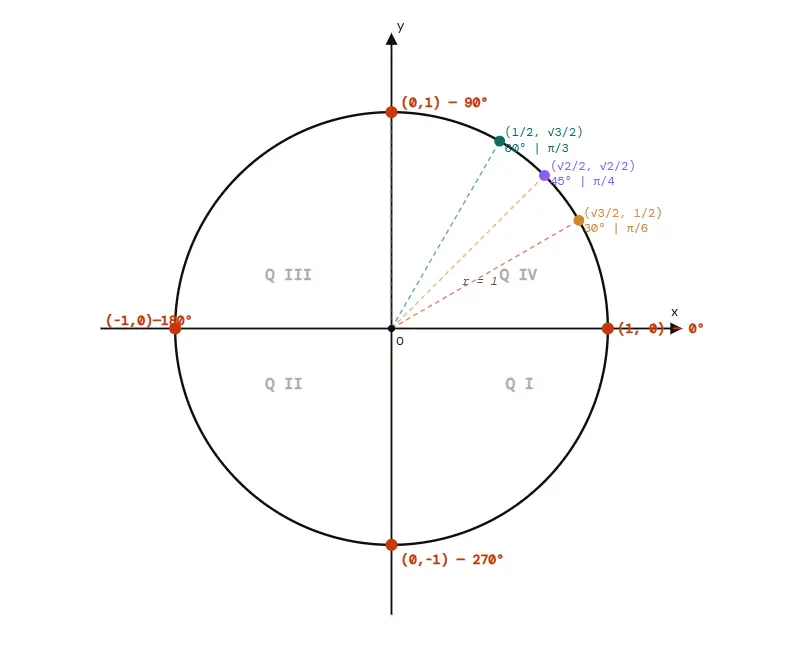
Most students are intimidated because the circle has 16 standard angles with coordinates that look impossibly similar. The good news: you only need to truly learn 3 values. Everything else falls out from patterns, symmetry, and two rules. That’s exactly what this guide teaches you.
The Complete Unit Circle Value Table
Here is every standard angle with its radian equivalent, and the corresponding sine, cosine, and tangent values. Bookmark this. Every method in this guide is designed to help you reconstruct this table entirely from memory.
| Degrees | Radians | cos θ (x) | sin θ (y) | tan θ |
|---|---|---|---|---|
| 0° | 0 | 1 | 0 | 0 |
| 30° | π/6 | √3/2 | 1/2 | √3/3 |
| 45° | π/4 | √2/2 | √2/2 | 1 |
| 60° | π/3 | 1/2 | √3/2 | √3 |
| 90° | π/2 | 0 | 1 | undefined |
| 120° | 2π/3 | -1/2 | √3/2 | -√3 |
| 135° | 3π/4 | -√2/2 | √2/2 | -1 |
| 150° | 5π/6 | -√3/2 | 1/2 | -√3/3 |
| 180° | π | -1 | 0 | 0 |
| 210° | 7π/6 | -√3/2 | -1/2 | √3/3 |
| 225° | 5π/4 | -√2/2 | -√2/2 | 1 |
| 240° | 4π/3 | -1/2 | -√3/2 | √3 |
| 270° | 3π/2 | 0 | -1 | undefined |
| 300° | 5π/3 | 1/2 | -√3/2 | -√3 |
| 315° | 7π/4 | √2/2 | -√2/2 | -1 |
| 330° | 11π/6 | √3/2 | -1/2 | -√3/3 |
| 360° | 2π | 1 | 0 | 0 |
Common Mistake
Many students confuse sin and cos at 30° and 60°. Remember: at 30°, sine is the smaller value (1/2) and cosine is the larger one (√3/2). At 60°, it flips. This is because as the angle rises toward 90°, the vertical leg (sine) grows and the horizontal leg (cosine) shrinks.
Method 1 – The 1-2-3 Pattern (Fastest Start)
This is the single most powerful shortcut for memorizing sine and cosine values in the first quadrant. Every value is a fraction with denominator 2 and a numerator that is a square root of 0, 1, 2, or 3.
Sine: Count 0 → 1 → 2 → 3 → 4
For sine, as the angle increases from 0° to 90°, the number under the square root counts up: 0, 1, 2, 3, 4. Then divide by 2 and simplify:
sin values (0° → 90°)
√0/2 = 0
√1/2 = 1/2
√2/2 = √2/2
√3/2 = √3/2
√4/2 = 1
cos values (0° → 90°)
√4/2 = 1
√3/2 = √3/2
√2/2 = √2/2
√1/2 = 1/2
√0/2 = 0
The rule: Sine counts up (0, 1, 2, 3, 4). Cosine counts down (4, 3, 2, 1, 0). They are mirror images of each other which makes sense, because cos θ = sin(90° − θ).
Pro Tip: You only ever need to memorize three numbers: 1/2, √2/2, and √3/2. The values at 0°, 90°, 180°, 270°, and 360° are always just 0, 1, or −1, which come for free from the axes of the coordinate plane.
Method 2 – The Left-Hand Trick (Zero Paper Required)
This is the method students swear by on exam day. You use your left hand as a physical reference tool. Each finger represents one of the five key angles in the first quadrant.
How the Hand Trick Works
Hold up your left hand, palm facing you. Assign one angle to each finger, left to right (pinky to thumb):
- 🤙 0° Pinky
- ☝️ 30° Ring
- 🖕 45° Middle
- 🤞 60° Index
- 👍 90° Thumb
To find sin and cos of any angle: Fold down the finger for that angle. Count the fingers below (toward the pinky) that number goes under the square root for cosine. Count fingers above (toward the thumb) that goes under the square root for sine. Divide both by 2.
Example: find sin 30° and cos 30°: Fold down the ring finger (30°). You have 1 finger below it → cos 30° = √1/2 = 1/2. You have 3 fingers above it → sin 30° = √3/2. ✓
Example: find sin 60° and cos 60°: Fold down the index finger (60°). 3 fingers below → cos 60° = √3/2. Wait that’s wrong! Let’s re-count: at 60°, the index finger is folded. Fingers below (ring, middle, index… no, below the folded index toward pinky): pinky, ring, middle = 3 fingers below → sine side has 3 → sin 60° = √3/2. Fingers above (toward thumb): just the thumb = 1 → cos 60° = √1/2 = 1/2. ✓
Hand Trick Memory Hook
“Below = cosine, Above = sine.” Below the folded finger counts for cosine; above counts for sine. Put both over √/2 and simplify.
Method 3 – The ASTC Rule for Signs Across All Quadrants
Once you know the values in the first quadrant, the only remaining challenge is getting the signs (+ or −) right in quadrants II, III, and IV. The ASTC rule solves this instantly.
All Students Take Calculus
The mnemonic “All Students Take Calculus” tells you which trig function is positive in each quadrant:
Quadrant II (90°–180°)
S
Students
Sine (+), cos/tan (−)
Quadrant I (0°–90°)
A
All
All functions (+)
Quadrant III (180°–270°)
T
Take
Tangent (+), sin/cos (−)
Quadrant IV (270°–360°)
C
Calculus
Cosine (+), sin/tan (−)
Reading order: Start top-right (Q1) and go counter-clockwise: All → Students → Take → Calculus. This matches the standard counter-clockwise direction of angle measurement.
Other popular mnemonics for the same rule include “Add Sugar To Coffee” and “A Smart Trig Class.” Use whichever sticks fastest for you. The meaning is identical: in QI all are positive; in QII only sine; in QIII only tangent; in QIV only cosine.
Method 4 – The Symmetry Shortcut (Work 4× Faster)
The unit circle is perfectly symmetric. Once you know the three coordinate pairs in the first quadrant, you can derive every other angle in 16 seconds using symmetry no memorization needed beyond Q1.
The Reference Angle Method
Every angle in Q2, Q3, and Q4 has a reference angle the acute angle it makes with the nearest part of the x-axis. The sine and cosine of any angle are equal (in absolute value) to those of its reference angle. Only the signs change, per the ASTC rule.
Reference angles by quadrant:
- Q1 (0°–90°): Reference angle = θ itself
- Q2 (90°–180°): Reference angle = 180° − θ
- Q3 (180°–270°): Reference angle = θ − 180°
- Q4 (270°–360°): Reference angle = 360° − θ
Example: Find sin(150°) and cos(150°). Reference angle = 180° − 150° = 30°. We know sin(30°) = 1/2 and cos(30°) = √3/2. We’re in Q2, where only sine is positive (ASTC: “Students”). So: sin(150°) = +1/2 and cos(150°) = −√3/2. Done.
Key Insight
The coordinate pairs in Q2 are the same as Q1 but with the x-value negated. Q3 has both values negated. Q4 has only the y-value negated. Visualizing this as a mirror-flip across each axis is faster than memorizing 12 additional pairs.
Method 5 – Derive Everything from Two Triangles
If you forget the values entirely, you can reconstruct them from scratch using two special right triangles. This is the deepest, most reliable method it works on any test, even if your memory blanks completely.
The 30-60-90 Triangle
Start with an equilateral triangle with all sides = 2 and all angles = 60°. Cut it in half vertically. You get a right triangle with:
- Hypotenuse = 2
- Short leg (opposite 30°) = 1
- Long leg (opposite 60°) = √3 (from the Pythagorean theorem: 2² − 1² = 3)
Now scale everything to a hypotenuse of 1 (divide by 2): sin 30° = 1/2, cos 30° = √3/2, sin 60° = √3/2, cos 60° = 1/2.
The 45-45-90 Triangle
Start with a square of side length 1. Draw the diagonal. The diagonal is the hypotenuse of an isosceles right triangle with legs of 1 and hypotenuse = √2. Scale to a hypotenuse of 1 (divide by √2): both legs become 1/√2 = √2/2. So sin 45° = cos 45° = √2/2.
These two triangles are the mathematical source of all unit circle values. Sketching them takes about 30 seconds. Every value in the table above can be derived from them no memorization required beyond the triangles themselves.
Method 6 – The Degree Spacing Pattern (30-15-15-30)
Remembering which angles exist on the circle can be just as confusing as remembering their values. Here is the pattern for placing all 16 standard angles correctly:
The 30-15-15-30 Spacing Rule
Starting at 0°, the gaps between consecutive key angles in Q1 follow the pattern: +30, +15, +15, +30. Then repeat around all four quadrants:
0° → +30 → 30° → +15 → 45° → +15 → 60° → +30 → 90°
90° → +30 → 120° → +15 → 135° → +15 → 150° → +30 → 180°
180° → +30 → 210° → +15 → 225° → +15 → 240° → +30 → 270°
270° → +30 → 300° → +15 → 315° → +15 → 330° → +30 → 360°
The mnemonic: “Thirty, Fifteen, Fifteen, Thirty” or simply “big, small, small, big.”
Converting Degrees to Radians
The conversion formula is: radians = degrees × (π / 180). For the key angles, the radian denominators follow a pattern you can memorize directly:
0° = 0 | 30° = π/6 | 45° = π/4 | 60° = π/3 | 90° = π/2
Note the denominators: 6, 4, 3, 2 counting downward. After 90°, the numerators increase while denominators repeat this same set.
Method 7 – Draw the Circle from Scratch Daily
This is the method that converts short-term recognition into permanent long-term memory. It requires no flashcards, no apps, and no external tools just a pen and a blank page.
The Daily Drawing Protocol
Each day, on a blank sheet of paper, draw the unit circle completely from memory in the following order:
- Draw the circle and axes. Label the four axis points: (1,0), (0,1), (−1,0), (0,−1) and their angles (0°, 90°, 180°, 270°).
- Place Q1 angles using 30-15-15-30. Draw radii to 30°, 45°, 60°.
- Label Q1 coordinates using the 1-2-3 pattern: (√3/2, 1/2), (√2/2, √2/2), (1/2, √3/2).
- Mirror to Q2 (negate x-coordinates, keep ASTC in mind).
- Mirror to Q3 and Q4 (negate appropriately).
- Write radian equivalents for each angle.
- Check your work against the reference table. Note any errors.
This takes about 8–12 minutes. After 5–7 days of consistent practice, most students can complete the full circle in under 3 minutes with zero errors.
Why Drawing Works
Writing activates motor memory a separate memory system from verbal recall. When you draw the circle repeatedly, you’re encoding it in multiple cognitive channels simultaneously: visual, spatial, and motor. This is why hand-drawn practice is more effective than passively studying a pre-printed chart.
7-Day Unit Circle Memorization Plan
This structured plan takes you from zero to full memorization in one week. Each session is 15–20 minutes. Do it consistently even on days it feels easy.
Day 1: Understand the Foundation
Study the definition of the unit circle. Learn why cos θ = x and sin θ = y. Memorize the four axis points (1,0), (0,1), (−1,0), (0,−1). Sketch the circle 3 times from memory with just the axes.
Day 2: Master Q1 with the 1-2-3 Pattern
Learn the 1-2-3 pattern for sine (counting up) and cosine (counting down). Draw Q1 five times. Practice the hand trick until you can derive any Q1 value without thinking.
Day 3: Learn the ASTC Rule + Q2
Memorize “All Students Take Calculus.” Apply it to Q2 same values as Q1 but cosine is negative. Draw the circle including Q1 and Q2 from memory. Practice 5 angle lookups in Q2.
Day 4: Expand to Q3 and Q4
Apply ASTC to Q3 (only tangent +) and Q4 (only cosine +). Draw the full circle from scratch twice. Quiz yourself on 10 random angles from any quadrant.
Day 5: Add Radians
Learn the radian equivalents using the denominator pattern (6, 4, 3, 2). Write the full circle including both degrees and radians. Cover the degree column and identify angles by radians alone.
Day 6: Speed Test Day
Set a timer for 8 minutes. Draw the complete unit circle (all 16 angles, both degree and radian labels, all coordinate pairs). Check against the reference table. Target: zero errors.
Day 7: Problem-Based Consolidation
Solve 20 trig problems that require unit circle lookups without consulting any reference. Include: finding exact values, identifying quadrants, and evaluating tan. This is exam simulation.
After Week 1
Do a single full drawing from memory once per week for the next month. This spaced repetition is what makes the unit circle stay in long-term memory. After one month of weekly review, most students retain it permanently.
Quick Reference Summary
- The 1-2-3 Pattern: Sine counts up (√0, √1, √2, √3, √4) over 2; cosine counts down.
- The Hand Trick: Left hand, palm facing you fold the finger for the angle; count below for cosine, above for sine, then divide by √ / 2.
- ASTC Rule: “All Students Take Calculus” which function is positive in each quadrant (Q1→Q4, counterclockwise).
- Reference Angles: Any angle’s trig values = its reference angle’s values ± signs from ASTC.
- 30-60-90 Triangle: Sides in ratio 1 : √3 : 2 derive 30° and 60° values from scratch.
- 45-45-90 Triangle: Sides in ratio 1 : 1 : √2 gives √2/2 for both sin and cos at 45°.
- Degree spacing: 30-15-15-30, repeating each quadrant.
- Daily drawing: 8–12 minutes of drawing from memory for 7 days → permanent retention.
Frequently Asked Questions
How long does it take to memorize the unit circle?
Most students can memorize all 16 angles and their coordinates in 5–7 days with 15–20 minutes of daily practice. The first quadrant can typically be memorized in a single 30-minute session using the 1-2-3 pattern. The full circle with radians usually takes about a week of consistent practice.
What is the easiest trick to memorize the unit circle?
The 1-2-3 pattern (also called the “counting trick”) is widely considered the fastest entry point. For sine, the numerators under the square root count 0, 1, 2, 3, 4 as the angle increases from 0° to 90°; for cosine, they count in reverse. Combined with the hand trick for quick recall and the ASTC rule for signs, these three methods together cover everything you need for any standard exam.
Do I need to memorize the unit circle in radians?
Yes most college-level math, including calculus and physics, uses radians as the default unit. The good news is that the radian denominator pattern (6, 4, 3, 2 for the first quadrant) is quick to learn. Think of π/6 as the “small” angle, π/4 as the “medium,” π/3 as the “larger,” and π/2 as the axis. Numerators increase predictably after 90°.
Is it better to memorize or understand the unit circle?
Both and they reinforce each other. Understanding why the values are what they are (via the special triangles and the Pythagorean identity) makes memorization significantly easier and more durable. Students who only rote-memorize without understanding tend to forget after exams. Students who understand the structure can always reconstruct values they forget.
What are the most important angles to memorize first?
Start with the four axis points (0°, 90°, 180°, 270°), then the three Q1 non-axis angles (30°, 45°, 60°). These seven angles give you the pattern for everything else. Once those are solid, extend to the other quadrants using symmetry and the ASTC rule. The 45° angle (π/4) is especially important as it appears very frequently in calculus and physics problems.
How do I remember which is sine and which is cosine on the unit circle?
Think of the coordinate pair as (cosine, sine) or (x, y). Cosine is the horizontal component (x-axis), sine is the vertical component (y-axis). A simple memory hook: “Sine is Sky-high it measures the Standing height (vertical distance).” Cosine is the “couch component” it measures how far across (horizontal distance).
What is the unit circle used for in real life?
The unit circle is the mathematical foundation for modeling all periodic phenomena. It is used in audio engineering (sound waves and Fourier analysis), electrical engineering (AC circuits and signal processing), computer graphics (rotation matrices and animations), GPS and navigation, architecture, robotics, and any calculus involving derivatives of trigonometric functions. Whenever you see a sine wave in audio, physics, or engineering the unit circle is beneath it.
What is the Pythagorean identity and how does it relate to the unit circle?
The Pythagorean identity sin²θ + cos²θ = 1 is a direct consequence of the unit circle definition. Because any point (x, y) on the circle satisfies x² + y² = 1 (the circle equation with radius 1), and since x = cos θ and y = sin θ, substitution gives the identity immediately. This identity is used constantly in calculus and trigonometric simplification.
READ NEXT: